
Table of Contents
ToggleArtificial Grass Installation in Dubai: Process, Cost and Maintenance Guide
-
 Laura Bathia
- May 25, 2026
- May 25, 2026
Most homeowners who contact us about Installing Artificial Turf Grass or comparing artificial turf installation services have already been through a bad experience. The lawn looked fine for six months. Then a seam showed up across the middle. A corner started lifting. Two patches dropped lower than the rest because whatever was underneath them had shifted. Good money spent, and the result looks worse than bare sand.
None of that came from the product. Every single one of those problems started under the turf, in decisions that were made before a single roll was laid.
The grass itself is the easy part. What separates a lawn that holds up for ten years from one that fails in eighteen months is the base preparation, the compaction, the drainage design, and how the seams are joined. Get those things right and the product does its job. Rush them and you're looking at a redo within two years.
This guide covers the full process honestly, what each step actually involves, what artificial grass costs in Dubai, what daily maintenance looks like, and what to ask any company before you hire them.
Why Artificial Grass is Popular in Dubai
Keeping a natural lawn alive here takes real work. Bermuda grass, the toughest variety available for UAE conditions, still needs irrigation several times a week through summer, mowing every week during the growing season, fertiliser every four to six weeks, and treatment whenever fungal issues or pests appear. That's a recurring cost and time commitment for as long as the lawn exists.
Plenty of villa owners are happy to do it. If that's you, artificial grass probably isn't the right call.
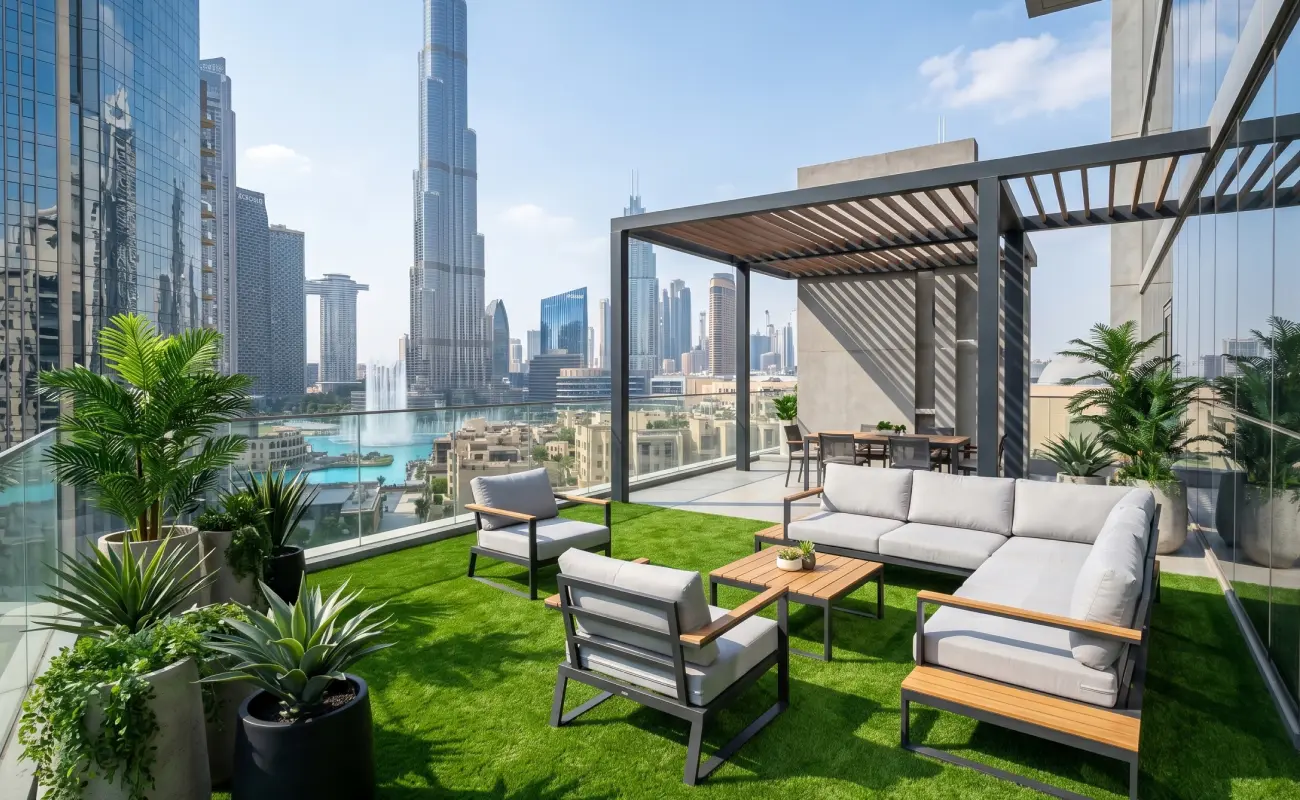
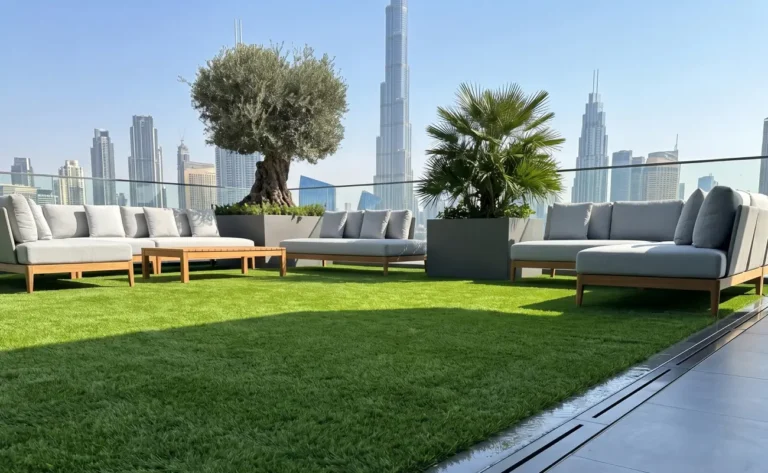
For rooftop terraces and balconies, it's frequently the only workable option. Natural grass needs real soil depth and consistent sunlight, and most terraces have neither. Artificial grass works on concrete, timber decking, and existing tile. It turns spaces that would otherwise sit unused into something worth spending time on.
For artificial grass for play areas, parents ask for it because there's no mud after rain, no bare patches worn through from heavy use, and nothing on the surface that kids rolling around on it shouldn't be in contact with. That last part is worth more thought than most people initially give it.
Why Artificial Grass is a Smart Choice for the UAE Climate
Minimal rainfall also works in artificial grass's favour. No freeze-thaw cycles, no sustained waterlogging, no moss or algae buildup. The surface stays stable year-round in ways it wouldn't in wetter climates.
The Artificial Grass Installation Process in Dubai
Each step below has a specific purpose. The ones that get dropped on cheap jobs are the ones responsible for the failure stories people call us about.
Step 1: Site Inspection and Area Measurement
A real site inspection isn't someone walking around with a tape measure. It's a proper look at what's actually there: what the substrate is, how drainage currently works or doesn't, how level the ground is, where sun falls throughout the day, and what the finished surface will be used for.
A rooftop terrace has structural load limits that a garden bed doesn't. A poolside job needs drainage planning that a backyard doesn't. A play area needs a different infill entirely. None of that comes from an address and a floor plan. Installers who quote without a site visit are working from guesswork, and you're the one who lives with what that produces.
Step 2: Removing Existing Grass or Soil
For garden installations, everything organic comes out. Existing grass, topsoil, roots, all of it. Depth depends on the base design but typically runs 100 to 150mm. Organic material breaks down over time, which means the surface above it drops unevenly. It also holds moisture, which creates drainage problems and gives weeds a place to establish from below.
On concrete substrates like rooftops and balconies, excavation is replaced by surface preparation. Clean the substrate, confirm it's sound, plan the layers going on top.
Step 3: Ground Leveling and Base Preparation
After excavation, the ground gets levelled properly. Not roughly flat but correctly graded, with falls toward drainage points. A surface that looks even to the eye can carry undulations of 20 to 30mm that become visible bumps and dips once turf is down. On play areas, those irregularities are a safety concern on top of an aesthetic one. Correcting level at this stage costs very little. Correcting it after the turf is installed means pulling everything up.
Step 4: The Sub-Base Layer
Crushed granite road base, typically 10 to 20mm graded, goes in across the full area. Standard depth in Dubai is 75 to 100mm. It compacts well, drains freely, and gives the turf a stable platform that doesn't shift under heat or load.
In locations with particularly sandy or unstable ground, which comes up regularly in older Sharjah communities and parts of Abu Dhabi, a geotextile separation layer goes below the aggregate. Without it, the base material slowly migrates into the sand below over several years and the surface loses its evenness.
Step 5: Compaction for Strong Foundation
The road base is compacted using a plate compactor, with multiple passes in different directions on larger areas. Aggregate that isn't properly compacted settles unevenly under foot traffic and furniture weight. Soft spots in the base show up as soft spots in the surface within months. This step takes time and it's where budget operators cut corners. The results show up quickly.
Step 6: Installing Weed Control Membrane
A woven geotextile membrane goes over the compacted base before the turf goes down. It prevents weed seeds in the base material from germinating and pushing through the turf over time. Weed pressure in Dubai's climate is lower than in temperate countries, but it's not zero, particularly on installations next to planting beds. The membrane also stops fine particles from working upward into the turf's drainage layer over the years.
Step 7: Artificial Turf Laying & Cutting
All rolls go down with the pile running in the same direction, toward wherever the lawn will most often be viewed from. The house, the pool terrace, the main seating area. Artificial grass has a directional quality, and the difference between looking with the pile versus against it is visible across any large area. Getting orientation right before cutting starts matters.
Once positioned, rolls are cut to the boundary with the seaming plan in mind.
Step 8: Jointing & Seaming Process
Every join between rolls has to be invisible in the finished result. That requires a clean straight cut on both edges, pile direction matched across the seam, blades interlocking to cover the join, and the right adhesive tape holding the backing flat from below.
A seam done well disappears. A seam done poorly is the first thing anyone notices. There's no repairing a bad seam without lifting the turf and starting that section again.
Step 9: Fixing and Edging
The perimeter gets fixed with galvanised nails or staples at regular intervals into the sub-base, or with adhesive bonding to a concrete border. Artificial turf expands slightly in Dubai's peak summer heat and contracts at night. The fixing method needs to allow for that movement without creating visible tension lines or lifting edges off the base.
On rooftop and balcony installations, adhesive fixing is used throughout. Nailing into concrete substrates isn't an option.
Step 10: Infill Application
Infill stabilises the pile, adds weight to keep the turf flat, and changes how the surface feels underfoot.
Silica sand is the standard choice for most residential work: villa gardens, backyards, terraces. It's inert, effective, and well suited to the application. Quantities on rooftop and balcony jobs are calculated carefully against structural load limits.
For artificial grass for play areas and sports surfaces, rubber crumb infill is specified instead. It provides the shock absorption required for play equipment fall zones. The depth of the rubber infill is what delivers safety performance, not the pile height of the turf above it.
Step 11: Brushing and Final Finishing
Once infill is distributed, the pile gets brushed against its natural lean using a stiff brush or power broom. This lifts the blades upright and works the infill down to the base of the pile where it belongs.
Unbrushed turf looks flat. Brushed turf looks like a real lawn. This takes twenty minutes on a small area and makes a significant difference to the finished result.
Step 12: Inspection and Handover
Before handover, the full installation is checked: seam quality, edges, pile direction consistency, infill distribution, surface levelness, and drainage performance tested with water. Anything not right gets fixed before sign-off. The client gets a walkthrough of the maintenance needs of the specific product installed.
Best Base for Artificial Grass Installation in Dubai
Compacted road base at 75 to 100mm depth is the correct foundation for ground-level garden work across Dubai, Abu Dhabi, and Sharjah.
On concrete, a foam shock pad or rubber underlay takes the place of aggregate. It handles minor surface irregularities, adds cushioning, and keeps structural load within safe limits.
Sharp sand, building sand, topsoil, and organic material don't belong in an artificial grass base. They move, hold water, and fail.
Drainage System for Artificial Grass
Low rainfall doesn't make drainage irrelevant. Two things make it matter regardless.
First, when Dubai does get significant rain, and recent years have shown how intense that can be, an artificial lawn without a drainage plan becomes a pond. It takes days to drain and standing water softens the base below.
Second, and more relevant day to day, cleaning artificial grass involves hosing it down. Removing dust, pet waste, and debris is a routine task. That water needs to clear quickly or you're walking on a wet surface long after a simple rinse.
Good artificial grass products have permeable backings that let water through into the aggregate base. The base then needs falls in the right direction, and on larger areas, a channel or soakaway built into the layout.
On rooftop and balcony installations, the surface fall connects to existing drainage outlets. That fall direction gets engineered during ground preparation, not worked out afterwards.
Artificial Grass Installation Cost in Dubai
The typical range for residential artificial grass installation in Dubai is AED 35 to AED 90 per square metre, fully installed. The difference across that range is real and comes from product quality, base specification, and site complexity.
Artificial Grass Costs in Dubai vary because product quality, drainage setup, groundwork, and site conditions all affect the final number. Turf grade drives most of the variation. Budget-friendly artificial grass uses simpler UV stabilisation and basic backing construction. It's cheaper upfront but degrades faster and looks less convincing. Mid-range products at 30 to 35mm pile with solid UV ratings and natural multi-tone colouring are the right call for most Dubai homes. Premium artificial grass installation at 40mm+ pile with extended UV warranties makes sense on front gardens, pool surrounds, and any area where appearance carries significant weight.
Base work adds cost when the site needs deep excavation, significant level correction, or a reinforced sub-base due to poor ground conditions.
Larger areas cost less per square metre because setup costs spread across more material. A small balcony costs more per square metre than a large villa garden.
Installation type changes the spec. Artificial grass for balcony and terrace work uses adhesive fixing, foam underlay, and reduced infill weight. That's a different material and labour profile than a ground-level garden.
Practical numbers: a 50sqm villa garden with mid-range turf and a proper base runs AED 6,000 to 9,000. A 20sqm rooftop terrace with premium turf runs AED 3,500 to 6,000. Play area installations with rubber crumb infill sit at the upper end of the range.
What Factors Affect Artificial Grass Installation Cost?
Turf grade and pile height. Base depth and ground conditions. Total area. Surface type. Infill specification. Edge treatment and drainage requirements. Additional elements like foam underlay or concrete border edging. A quote built on an actual site visit will always be more accurate than a per-square-metre figure applied without seeing the job.
Best Artificial Grass Thickness for Dubai
For villa gardens, backyards, and outdoor areas generally, 30 to 35mm pile is the practical choice. It looks and feels right underfoot, holds its appearance over time, and handles the UAE climate well.
Below 25mm starts looking thin and flat within a year or two. Above 40mm is worth it on high-visibility areas where premium appearance is a priority, but unnecessary elsewhere.
For balconies and terraces, 20 to 25mm with a lighter backing is more practical. Heavier products push against the load limits of most roof structures.
For play areas, pile height is secondary. Rubber crumb infill depth is what matters for safety, not blade length.
Artificial Grass Installation for Different Areas
Villa Garden Artificial Grass Installation
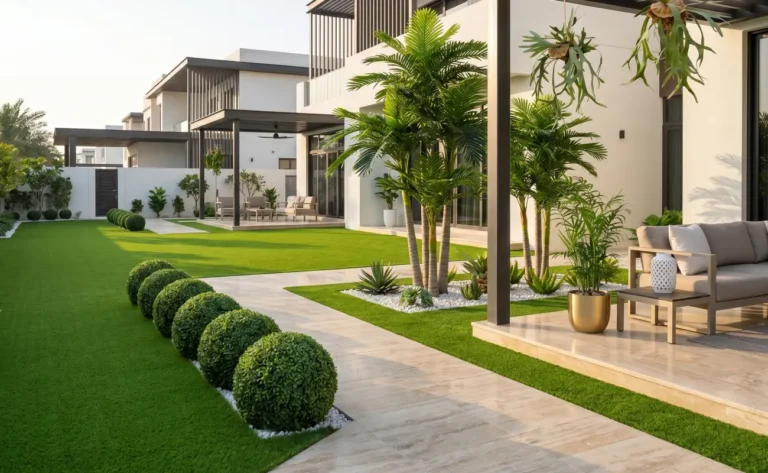
Villa gardens across Dubai communities like Arabian Ranches, Jumeirah, Dubai Hills, and Mirdif tend to have the space for a full aggregate base installation done properly. The goal is a seamless lawn that reads as part of the wider garden design rather than something dropped into it. Seam positions get planned around the main sightlines from the house and terrace. On larger plots, running one wide roll along the longest axis reduces the number of seams needed.
Backyard Artificial Turf Installation
Backyards in UAE villas and townhouses usually come with complications: irregular shapes, walls at awkward angles, drainage outlets in inconvenient spots, planting beds along the edges. A good installation works around all of it without showing the effort. Backyards in Sharjah areas like Al Nahda and Muwaileh often have older drainage setups that need to be factored into the design from the start.
Rooftop and Terrace Artificial Grass Installation
Rooftop jobs need the most careful planning. This is exactly where Artificial Grass for Balconies & Roof Terraces becomes one of the most practical solutions in Dubai. Structural load limits, waterproof membrane protection, drainage routing to existing outlets, and adhesive fixing throughout. When it’s done right, a concrete rooftop becomes a space people actually use. It’s one of the more impactful changes available for apartments and penthouses across Dubai, Abu Dhabi, and Sharjah.
Poolside Artificial Grass Installation
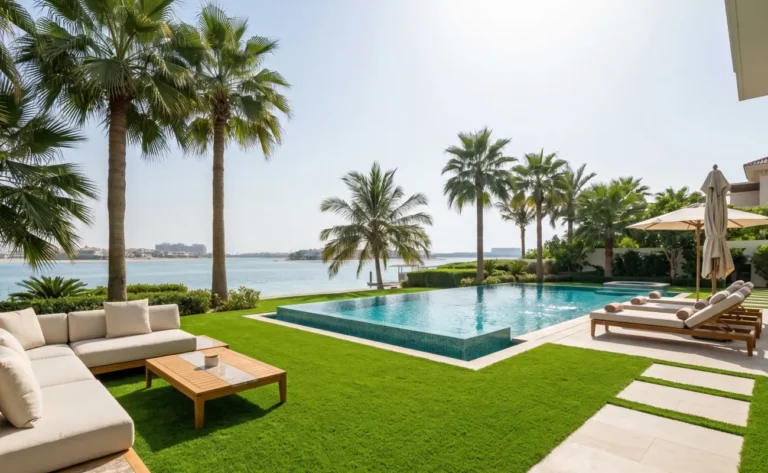
Poolside turf lives in a tough environment: chlorinated water splashing onto it constantly, wet feet all day, and reflected UV off the water surface, adding to direct sun exposure. Drainage needs to handle continuous moisture. UV stabilisation needs to account for reflected radiation, not just overhead sun. Premium turf grades earn their cost at poolside more than anywhere else in a garden.
Artificial Grass For Balcony Installation
Balcony work is compact but technically precise. Adhesive fixing throughout. Edge finishing tight against railings, door thresholds, and drain channels. Surface falls toward existing drainage outlets. Pile height of 20 to 25mm fits the space without overpowering it visually and stays within what most balcony drains can handle. A well-installed balcony with artificial grass changes how the space gets used, even on small areas.
Artificial Grass for Play Areas
Safety comes first and everything else follows from that. Rubber crumb infill at the depth required for the fall height of any equipment on site. Lead-free turf with certified clean materials. EPDM or clean SBR rubber crumb, not lower-grade alternatives. Impact attenuation testing before handover on any installation near climbing frames or play structures. The turf product matters less here than the infill specification beneath it. The same installation logic also applies to Artificial Grass for Sports Surfaces, where shock absorption, drainage, and durability matter just as much.
Artificial Grass vs Natural Grass in Dubai
| Key Factor | Artificial Grass | Natural Grass (Bermuda) |
|---|---|---|
| Upfront cost | Higher | Lower |
| Water requirement | None | Regular irrigation year-round |
| Maintenance | Periodic brushing and rinsing | Weekly mowing, monthly feeding, pest treatment |
| Summer appearance | Consistent all year | Can yellow without intensive care |
| Lifespan | 8 to 15 years by grade | Ongoing, no fixed lifespan |
| Best for | Rooftops, balconies, play areas, and low-maintenance gardens | Large open lawns with direct sun and regular family use |
| Kids and pets | Safe, no chemicals, drains cleanly | Safe but carries fertiliser and pesticide residue |
How to Choose an Expert Artificial Grass Installation Services Provider in Dubai
The market has a wide range of operators. Here’s what actually separates good from poor.
Ask about their base specification. Compacted sand or existing soil with no road base layer is not an acceptable answer. Ask how drainage is handled on a job like yours. Ask to see close-up photographs of completed seams, not just wide garden shots. A proper seam is invisible at two metres. A poor one shows in any photo.
Ask about the product: manufacturer, UV warranty, infill specification for the application. Ask whether they handle base preparation with their own crew or subcontract it. Companies that hand off base work often have no real visibility into whether it’s been done correctly.
An expert artificial grass installation services provider in Dubai should answer all of these without hesitation and with specifics. Vague responses are a signal worth taking seriously.
Complete Artificial Grass Solution by Golden Seed
Every job starts with a site inspection. Base preparation is handled by the same crew doing the installation, not passed to a subcontractor. Product selection is matched to the application: UV rating, pile height, backing, and infill type all chosen for where the turf is going and what it needs to do. Inspection and drainage testing happen before every handover.
For anyone weighing budget-friendly artificial grass against premium artificial grass installation options, Golden Seed gives honest guidance on where spending more makes a difference and where it doesn’t. A mid-range product on a well-built base consistently outperforms a premium product on a poor one.
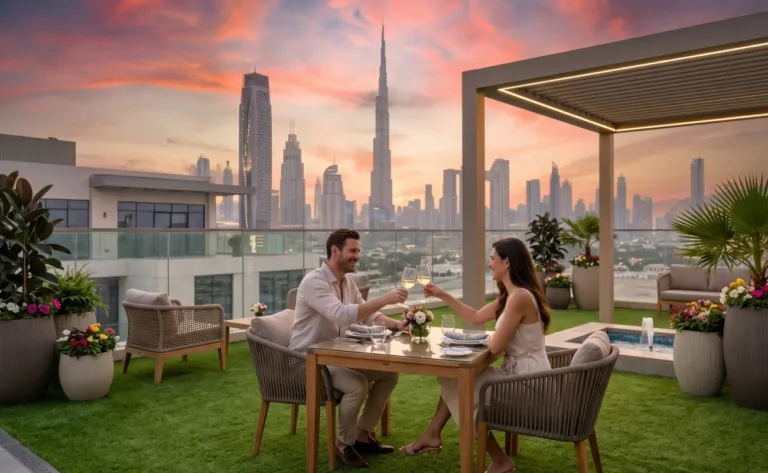
A JVC rooftop terrace, 35sqm on concrete with one drain outlet, was installed with 20mm pile turf, foam underlay, adhesive fixing throughout, and a surface fall designed toward the drain. The client uses it as an outdoor dining area year-round with no drainage or fixing problems since day one.
How to Maintain Artificial Grass in Dubai
Low-maintenance is not the same as no maintenance. Turf that looks good at year eight usually has one thing in common with turf that looked tired at year four: consistent basic care.
Weekly or fortnightly: Brush high-traffic areas with a stiff broom to keep the pile upright. Hose the surface down every one to two weeks to clear the dust that settles on everything in Dubai. Ten minutes.
Monthly: Walk the edges and check for lifting. Look at the seams. Heat cycling over years puts stress on fixing points and seam tape. A small lift is a quick fix if caught early. Left alone for six months it becomes a much bigger job.
Pet owners: Flush pet waste areas promptly. The drainage backing handles liquid but residue needs to be rinsed through. A diluted enzymatic cleaner deals with odour without harming the turf or infill. Bleach-based cleaners degrade the pile fibre over time.
Annually: Top up infill in worn areas. A brush and infill service once a year keeps the surface even and extends the life of the product considerably.
Conclusion
Artificial grass works well in Dubai when it’s installed properly. It removes the irrigation cost, the maintenance time, and the constant battle to keep natural grass alive through UAE summers. Done right, it holds up for ten years or more and looks good throughout.
Done poorly, it fails fast. Installation quality matters more than the product grade. A solid mid-range turf on a well-built base will outlast an expensive product on a rushed installation by years. Ask the questions that matter before committing to any company, and don’t make price the only consideration.
FAQs
Yes, and anyone who says otherwise isn’t being honest. Artificial grass in direct Dubai sun gets warmer underfoot than natural grass because it doesn’t have the same evaporative cooling. Premium UV-stabilised products run cooler than cheaper ones. A quick hose down before use drops the surface temperature fast. For play areas in the hottest months, shade is worth building in regardless of what the surface is made from.
Yes, with the right product. Confirm the turf is certified lead-free and free from harmful treatments. Ask for documentation. For play areas, rubber crumb infill should be EPDM or clean SBR. For pets, the drainage means waste rinses away without pooling, and the surface carries none of the pesticide or fertiliser residue that natural lawn maintenance involves.
AED 35 to AED 90 per square metre all included, depending on product grade, base spec, and site complexity. A 50sqm villa garden with mid-range turf and a proper base typically costs AED 6,000 to 9,000. A 20sqm rooftop terrace with premium turf costs AED 3,500 to 6,000.
Compacted road base at 75 to 100mm for ground-level work. Foam shock pad or rubber underlay on concrete for rooftops, balconies, and terraces. Not sharp sand. Not building sand. Not topsoil.
Regular housing handles most of it. For heavier buildup, a mild soap solution with a soft brush, then a full rinse, works well. High-pressure washers used regularly will degrade the pile fibre and backing over time, so keep them for occasional deep cleans rather than routine maintenance.